

Putting communities at the heart of Cheshire and Warrington’s devolution story
Deputy CEO, John Heselwood, reflects on the launch of the Cheshire and Warrington Combined Authority and what feels like an important moment for the sub-region…
After years of debate about devolution, local growth, infrastructure and public service reform, Cheshire and Warrington now has a real opportunity to show what more local control can achieve.
The new Cheshire and Warrington Combined Authority has already created an impressive story around high growth, with new powers, investment and influence over issues that shape everyday life: homes, transport, skills, economic development and strategic planning.
The challenge is to ensure that devolution is not just about growth for growth’s sake, but about better outcomes for communities.
That means asking a simple question: how can the Combined Authority use its powers, partnerships and investment to help every part of Cheshire and Warrington thrive?
At the recent launch conference, I was pleased to contribute to the Rural Futures panel on behalf of Cheshire Community Action. The discussion was a useful reminder that rural Cheshire and Warrington is not peripheral to the sub-region’s future. It is central to it.
Rural areas support food production, farming, land-based industries, the visitor economy, energy, high-value businesses, community life, biodiversity and quality of place. They are home to significant enterprise, innovation and social capital. They are also closely connected to our towns, industrial centres and urban communities.
That connection matters. Cheshire and Warrington has an impressive economic story to tell, from farms to pharma, dairy to data centres, market towns to world-class life sciences. But this will only be a genuinely inclusive story if the communities behind those strengths are able to shape, access and benefit from the opportunities created.
The forthcoming Rural Needs Analysis, to be published by the Cheshire & Warrington Rural Strategy Group, makes clear that rural potential is still being held back by long-standing structural barriers. These include digital connectivity, transport, housing affordability, access to skills, infrastructure capacity, fragile local services and under-investment in community infrastructure.
These issues are not separate. They interact with each other.
- Poor digital connectivity limits rural business growth, remote working, farming innovation, access to services, digital health, skills delivery and community-led service models.
- Weak transport links make it harder for people to access jobs, education, health appointments, training and town centres.
- A lack of affordable and appropriate housing pushes younger people, key workers and lower-income households out of rural communities.
- Fragile village halls, community centres and local hubs reduce communities’ capacity to host services, support residents and respond to local needs.
Many of these issues have arisen because of local market failures. In some places, investment has not come forward because the financial return is too low, too slow or too uncertain. But if the Combined Authority is serious about tackling chronic under-investment, it will need to look beyond commercial return alone and consider the wider social, economic and environmental value that investment can create.
Some of the most important investments are those that make places work better for people: a reliable bus link connecting remote rural areas, a village hall that can host health and advice services, affordable homes that allow local families to stay, digital connectivity in remote areas that supports small businesses, or community services and spaces that reduce isolation and build local resilience.
These investments may not always produce an immediate commercial return, but they can produce lasting social, economic and environmental value. Cheshire Community Action and its partners continue to develop work on articulating the social value of relatively small investments in voluntary and community services and infrastructure, showing how they can unlock wider benefits for people and places.
This is why the Rural Needs Analysis is so important. It provides an evidence base to make the case that rural investment is not a special interest issue. It is an economic, social and environmental necessity.
The same principle applies beyond rural areas.
If devolution is to succeed, it must also help tackle chronic deprivation and under-investment in some urban communities. Cheshire and Warrington has some of the most successful and strategically important industries in the country sitting alongside communities that have not always benefited from that growth.
Ellesmere Port, Crewe, Warrington and other places all show the importance of connecting major economic opportunity with local social benefit.
It is not enough to talk about the manufacturing jobs of the future if local people cannot access the skills, transport, housing, health support and community infrastructure needed to benefit from them. It is not enough to secure investment if it does not create stronger local supply chains, more resilient communities and better outcomes for those who have too often been left behind.
This is where the Combined Authority has the opportunity to add real value. It can help bring together decisions that have too often been made separately: housing, transport, skills, health, digital, economic development, climate, infrastructure and community capacity. Above all, it can help make sure that investment is shaped by the realities of local places.
The Combined Authority has recently approved a £3m investment in town centres, cultural activity and community assets as part of its pledge to engage with local communities and ensure residents and businesses benefit from devolution. This is a welcome early signal of intent. We will await further details of the £3m investment and keep our members and partners informed as opportunities become clearer.
A big part of the Combined Authority’s first year is about building the relationships and laying the foundations to deliver better services and improved outcomes for local people going forward. But this requires meaningful involvement from communities and the voluntary, community, faith and social enterprise sector from the start.
Too often, communities and the voluntary sector are seen as voices to consult, barriers to overcome, or delivery bodies to involve once the main decisions have already been made. Devolution gives us the chance to do that differently.
Communities should be treated as equal partners in shaping priorities, designing services and delivering solutions. Parish councils, community organisations, village halls, social enterprises, community businesses, charities, faith groups and local networks all hold knowledge, trust and relationships that cannot be replicated from the centre.
This is not just about fairness or representation. It is also about better delivery.
Local insight can help identify what will work, where investment is most needed, and how services and developments can be designed to deliver better outcomes. Community and VCFSE involvement can help avoid investment being poorly targeted, duplicated or disconnected from local need.
That means recognising the community infrastructure that already exists and investing in its capacity to do more. Community buildings, local charities, parish and town councils, social enterprises, community businesses, faith groups and local networks often provide the trusted spaces and relationships through which services can reach people. But they need the right conditions, support and investment to thrive.
Cheshire Community Action has been working closely with partners through the Cheshire and Warrington Infrastructure Partnership to ensure that the needs and ambitions of the voluntary, community, faith and social enterprise sector are part of the conversation as the Combined Authority develops. This includes investment proposals that can benefit communities directly and help build sector capacity during the first year of the Combined Authority’s life.
The Combined Authority’s proposed Independent Economic Review should be an important route for this conversation. If it genuinely brings together economic evidence, lived experience and community insight, it can help shape investment decisions that reflect the realities of local life.
This matters because the promise of devolution is not simply that decisions are made closer to home. It is that better decisions are made because they are informed by local evidence, local relationships and local ambition.
For me, the test of devolution is whether we can move from growth being something that happens to communities, to growth being something shaped with communities.
If Cheshire and Warrington can do that, it can deliver not just economic growth, but better places and better lives.
John Heselwood – Deputy CEO, Cheshire Community Action
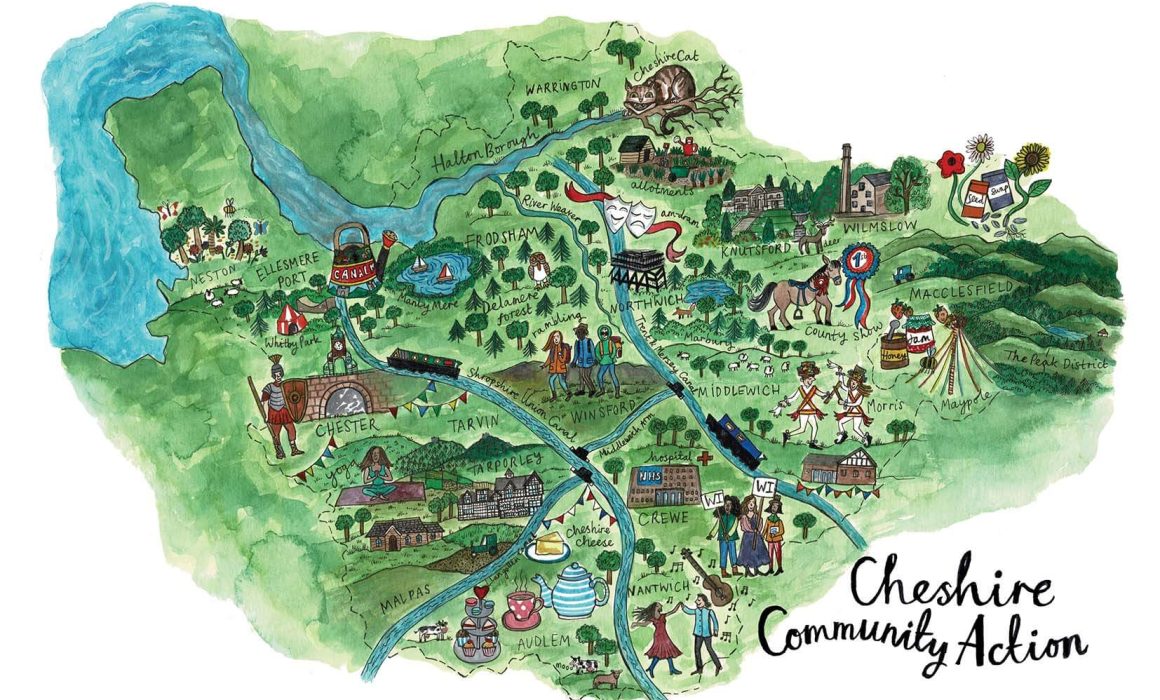
Image by Sophia Shaw
We aim to give Cheshire communities a stronger voice by engaging with and supporting them in influencing the places, spaces and services that are important to them.
We work throughout Cheshire West & Chester, Cheshire East, Halton, and Warrington. Although we were originally founded to assist rural communities, in recent years, we have branched out to provide support in larger towns and their suburbs.